

 English




Achieving Controllable ANC in Hybrid Driver Systems: AncSonic’s System-Level Acoustic Engineering Path
 2025.12.24
 1190
1190
In the true wireless earphone market, hybrid driver architectures that combine balanced armature and dynamic drivers are widely regarded as a benchmark for sound quality—but rarely for high-performance active noise cancellation (ANC). This is not an industry prejudice. It stems from a fundamental acoustic reality: effective ANC depends on a stable and predictable low-to-mid-frequency acoustic response, while balanced armature drivers, with their high-Q resonance and strong mechanical reactance, are designed to enhance mid- and high-frequency detail—often at the expense of phase stability and soundfield predictability inside the ear canal.
In a conventional hybrid configuration, ANC is primarily generated by the dynamic driver, yet the balanced armature remains an inseparable part of the acoustic system. Its passive interaction with the front-chamber acoustic load alters the system’s impedance, phase behavior, and resonance structure, making the overall response significantly harder to model and control. This intrinsic complexity is the true reason why the industry has long believed that hybrid earphones are ill-suited for strong, stable ANC.
Against this backdrop, AncSonic has established a distinct technical path. The robust, mass-production-grade ANC achieved in its hybrid earphones is not the result of an isolated technical breakthrough, but of a deeper, system-level understanding and control of complex acoustic interactions.
In AncSonic’s engineering philosophy, a hybrid system is never treated as a simple combination of two drivers. It is conceived from the very beginning as a fully integrated acoustic system whose stability must be compatible with an ANC feedback loop. The selection of the balanced armature, its operating band, and its influence on the front-chamber acoustic load are all incorporated into a unified acoustic model at the earliest design stage. Through coordinated optimization of acoustic crossover networks, damping schemes, and front-chamber geometry, AncSonic effectively decouples the balanced armature’s high-Q resonance region from the frequency bands where ANC operates. This prevents phase discontinuities and resonance spikes from destabilizing the noise-cancellation loop, while preserving the resolution and layering advantages that hybrid drivers are designed to deliver. As a result, the low-frequency acoustic system required by ANC remains highly predictable, even within a more complex multi-driver architecture.
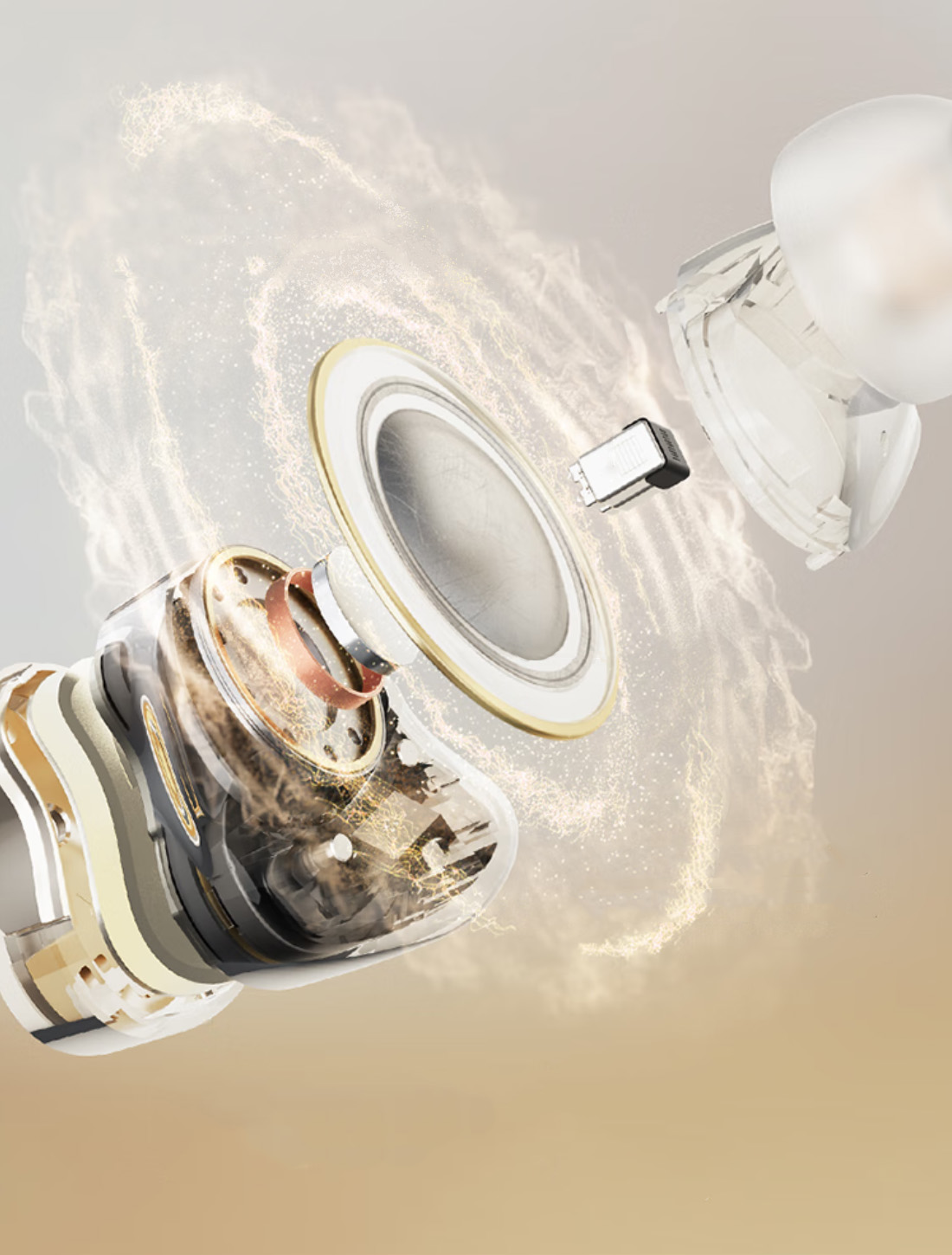
This system-engineering mindset extends directly into algorithm design. Compared with single-dynamic-driver earphones, hybrid systems create a far more variable ear-canal soundfield, placing much higher demands on the stability and robustness of ANC algorithms. Rather than chasing maximum laboratory noise-reduction figures, AncSonic models real-world variability—driver coupling, front-chamber changes, and individual wearing differences—and builds these uncertainties into the algorithm’s control margins. The outcome is an ANC system that remains stable across different fits, users, and environments, rather than one that relies on aggressive tuning that only performs well under ideal conditions.
Hardware implementation and system integration further amplify the challenge. Inside the extremely confined space of a true wireless earphone, multiple drivers, microphones, batteries, and highly integrated chipsets coexist. Any mechanical vibration, power-supply ripple, or RF interference can be amplified by the ANC feedback loop and perceived as audible noise. AncSonic therefore designs for mass-production consistency from the outset, applying system-level control over microphone placement, structural isolation, power architecture, and RF routing. By suppressing noise at its physical source rather than relying on post-processing compensation, AncSonic ensures that hybrid ANC performance is not only achievable in prototypes but also repeatable at scale.
Product definition is guided by the same system-balance philosophy. Hybrid drivers and continuous ANC both place significant demands on power consumption, so AncSonic deliberately optimizes the trade-offs between noise-reduction depth, sound quality, and battery life. The goal is not to maximize a single specification, but to deliver a stable, comfortable, and sustainable user experience in real-world use.
These system-level capabilities have been validated in commercially successful products developed with global partners, including the EarFun Air Pro 4+ and SoundPEATS H3, whose performance in both noise-cancellation stability and tonal balance demonstrates the practicality and scalability of AncSonic’s hybrid ANC approach.
AncSonic’s achievement in bringing controllable ANC to hybrid architectures is not about defying physics, but about transforming complexity into something that can be engineered, modeled, and reproduced. The true limitation of hybrid ANC has never been the balanced armature itself—it is the depth of understanding and the level of system control behind the design. When acoustic architecture, algorithms, and manufacturing discipline are aligned, hybrid drivers can deliver noise-cancellation performance that is both powerful and reliable.
In high-complexity systems, the ability to consistently deliver predictable, high-quality user experience is the ultimate engineering benchmark—and it is this capability that AncSonic has built through years of deep engagement in intelligent acoustics.
 Previous
News
Making Waves in Times Square: AncSonic Brings Cutting-Edge AI Acoustic Technology to the World
2026.09.09
Appearing in Times Square marks an important milestone in AncSonic’s journey onto the global stage.
AncSonic × 1MORE | 1MORE HQ60 Flagship Over-Ear ANC Headphones Officially Launch
2026.08.21
The launch of the HQ60 also demonstrates the practical application of AncSonic’s edge AI acoustic technology in flagship consumer electronics.
When the Cabin Becomes a Mobile KTV: AncSonic’s Full-Stack Acoustic Solution for Mic-Free Karaoke
2026.07.01
AncSonic’s mic-free karaoke solution adopts a system-level acoustic processing architecture, covering the entire chain from pickup and interference suppression to sound rendering, delivering a clear, stable, and low-latency singing experience in complex in-vehicle acoustic environments.
SORC Spatial Audio Powers the Open-Ear Experience on EarFun Clip 2
2026.04.03
The launch of the EarFun Clip 2 marks a key milestone in the maturity and real-world validation of spatial audio in open-ear applications.